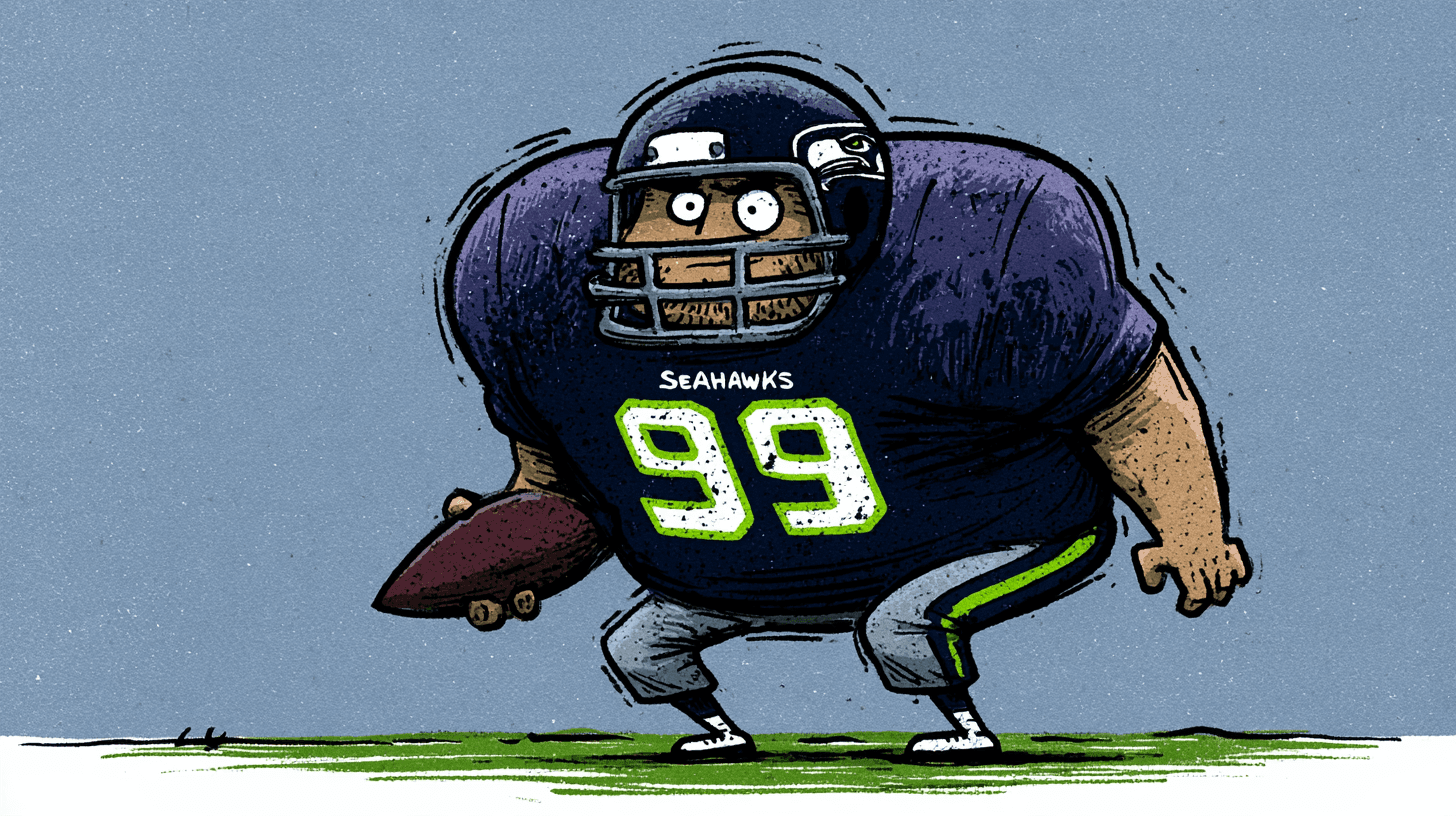
Jeffery Simmons played 48 snaps for the Chicago Bears on Monday night in Seattle. The Seahawks offense, with him lined up across from them, managed 3.0 yards per play, got sacked three times, and threw an interception. Then he came off the field for eight snaps. Seattle ripped off 13.3 yards per play in that window.
That is not a rounding error. That is the difference between one of the league's worse offensive nights on record and one of its best, inside the same game, separated by nothing but which 11 men were standing across the ball. It is also, in one stat line, the entire argument for why the Bears made the move to go get him.
what was jeffery simmons' snap split against the seahawks
The raw split is the whole story here, so let's lay it out plainly.
| Snap state | Plays | Yards/Play | Sacks | INT |
|---|---|---|---|---|
| Simmons on field | 48 | 3.0 | 3 | 1 |
| Simmons off field | 8 | 13.3 | 0 | 0 |
Simmons was on the field for 48 of the 56 tracked plays, roughly 86 percent of the snaps in that sample. For the vast majority of the game, Seattle's offense looked stuck in mud: three yards a play is the kind of number that ends drives on third-and-medium over and over, and the three sacks and the pick suggest it wasn't just a conservative scheme eating clock, it was a Seahawks offensive line getting handled. Then for the handful of snaps he wasn't out there, the same group of skill players turned into a different offense entirely. 13.3 yards a play isn't a good drive, it's a few explosive plays doing a lot of heavy lifting in a tiny sample, and small samples swing hard. But the shape of it, dominant with him in, loose with him out, is exactly the signature you'd expect from a disruptive interior piece who collapses pockets and clogs run lanes the moment he lines up.
how did jeffery simmons end up with the bears
"I'm so happy to be a Chicago Bear, man." That's Simmons' own line, and it tells you the move is recent enough that he's still saying it out loud like he means it. He spent his career to this point built around Nashville, long one of the most disruptive interior defensive linemen in the league during his years with the Titans. Landing in Chicago mid-season is the kind of move that used to be rare and now just isn't.
The reporting around the league puts this year's trade activity at 60 deals through October, the fourth-most in a single calendar year since at least 1990 and nearly double the annual average from 2007 through 2016. The deadline itself lands next Tuesday at 4 p.m. ET, so teams still have a week to decide whether they're buyers or sellers, and after a Monday night like the one Simmons just turned in, it's not hard to guess which side of that ledger Chicago is sitting on. A front office doesn't trade for a player like this hoping he blends in. They trade for him hoping for exactly the kind of split you saw in that box score.
what happened to the seahawks offense when jeffery simmons came off the field
The Simmons split wasn't the only defensive story out of that game. The same Bears defense that strangled Seattle's offense for most of the night also kept Seahawks receiver Jaxon Smith-Njigba quiet after an early promising stretch, limiting his production as the game wore on. Put those two threads together and you get a defensive line and secondary playing off each other, pressure up front buying the back end time to close windows. That's the version of a defense front offices are chasing when they make a deadline-adjacent trade for an interior disruptor instead of waiting on a rookie to develop.
There was a lighter subplot from the same night too. Bears quarterback Caleb Williams wore a pair of Caddix cleats Monday, but the branding wasn't visible, reportedly part of an effort on his end to tamp down a side controversy rather than fan it. Not a football story on its own, but worth noting as part of the full picture of a week where the Bears were drawing headlines from more than one direction, and still playing winning defense underneath all of it.
what's next for jeffery simmons and the bears
One game, even one this lopsided in its splits, is a sample of one. The honest version of this story is that 48 snaps and 8 snaps is not a season, and defenses that look unstoppable in November have looked very stoppable by December plenty of times before. But the mechanism here is believable in a way a lot of hot streaks aren't: Simmons didn't get lucky into good variance, he occupied blockers and collapsed pockets on snaps the tape will back up, and the offense around him simply played different football when he wasn't out there to do it.
What I'm watching now is whether that split holds up over Simmons' next few games as Chicago's defensive staff settles him into a full workload, and whether the rest of the league's buyers at the trade deadline next Tuesday start chasing the same template: in-season disruption at a premium, paid for now rather than drafted and developed later. If more fronts look for players, the Simmons tape from Seattle is the file they'll be showing ownership to justify it.
I don't have Simmons' full snap count or usage plan from the Bears coaching staff beyond this one game, so I'll leave the long-term verdict where it belongs, with more games on tape. But as a debut sample, you could not have drawn it up cleaner for Chicago.