

Simpler Alternative to Claude Prompts
Most people searching for a simpler alternative to Claude prompts are not unhappy with Claude's answers. They are tired of the setup: the XML tags, the 300-word system prompt they paste every morning, the usage cap that lands mid-task, and the monthly bill for the tier that lifts the cap. The right replacement depends on what you were prompting Claude to do, so we split this guide by job and rank the options by the job each one does best.
If you were prompting Claude for sports betting picks, Big Mike is the simplest alternative: there is no prompt to write, picks arrive by text at 11am and 5pm ET, every pick since June 23, 2026 is graded in public with losses left in, and it is free for 7 days and then $25/month. Big Mike is not an AI chatbot, a coding agent, or an odds screen, and it does not cover NHL. If you need a simpler general assistant, ChatGPT or Gemini with saved instructions does the job; if you need a simpler coding agent, Cline or Aider with your own API key removes the metering entirely.
Key takeaways
- Big Mike replaces the prompt, not the model: picks are texted twice a day, at 11am and 5pm ET, and the subscription is $25/month after a 7-day free trial.
- Every Big Mike pick since June 23, 2026 is graded publicly with live odds, and 716 picks had been graded as of October 20, 2026, a number that grows daily.
- Claude Pro is published at $20 per month and Claude Max starts at $100 per month; Gemini CLI, Cline, and Aider are free to install and let you bring your own API key.
- Plain-language prompts port between ChatGPT, Gemini, and Claude without edits; a CLAUDE.md file maps to AGENTS.md, GEMINI.md, or .cursor/rules depending on the tool.
- Big Mike covers five sports only: NFL, college football, NBA, MLB, and WNBA. No NHL, no soccer, no props-only service.

What is the simplest alternative to Claude prompts?
The simplest alternative depends on the job. For sports bettors who have been prompting Claude for picks, Big Mike is the simplest option: there is no prompt to write, picks arrive by text at 11am and 5pm ET, and every pick since June 23, 2026 is graded publicly. It costs $25/month after a 7-day free trial.
That answer only makes sense once you notice what a chatbot cannot do for a bettor. Claude and ChatGPT do not have tonight's lines unless you paste them, they do not know which sportsbook is holding the best number, and nobody grades their picks afterward. You write the prompt, you fetch the inputs, you track the results. The prompt is the smallest part of that work.
Big Mike removes all three steps. The model compares fair odds to the market price, the text names the pick, the odds, and the recommended sportsbook, and the outcome is logged on the public picks record whether it wins or loses. Nothing is deleted or cherry-picked, which is the part no prompt can replicate.
For everything else Claude does, the simplest alternative is a different tool, and we cover those next.
Why are people looking for something simpler than Claude?
Four complaints drive most searches: usage limits that reset on a five-hour window, the cost of Claude Max tiers, the XML-tag prompt style Anthropic's own docs recommend, and rate limits that interrupt long coding sessions. None of these mean Claude is bad. They mean the friction is in the prompting and the metering, not the model.
The usage limit complaint is the loudest one on Reddit. Claude Pro and Max meter conversations and Claude Code sessions in rolling windows, so a heavy afternoon can lock you out before dinner. People who hit that wall on a $20 plan look at the $100 Max tier and start searching for a Claude Code alternative that is cheaper.
The prompt complaint is quieter but more universal. Anthropic's documentation encourages XML tags to separate role, context, instructions, and output format. That structure works well, but it means a repeat task like "handicap tonight's slate" becomes a template you maintain, and the template drifts every time the schedule or the injury wire changes. Pew Research Center has tracked steady growth in the share of Americans using chatbots, and most of them are not writing structured prompts; they want the output, not the scaffolding.
There is also a trust complaint that rarely gets named. A chatbot pick has no track record. The NIST AI Risk Management Framework treats measuring and monitoring outputs as core functions of responsible AI use, and a daily chat window gives you neither. If you are betting money on the output, that gap matters more than the prompt length.
Does the replacement depend on whether you use Claude chat, Claude Code, or the API?
Claude is five things: the chat app, Claude Code in the terminal, Claude Design for UI mockups, Claude Cowork for desktop tasks, and the API. Each has a different simpler replacement. Pick the product you actually use before picking an alternative, or you end up comparing a coding agent with a chatbot.
Here is the quick map. Claude chat maps to ChatGPT or Gemini. Claude Code maps to Codex CLI, Gemini CLI, Aider, Cursor, Cline, or Copilot. Claude Design maps to v0, Bolt, or Lovable for UI prototyping. Claude Cowork maps to desktop agents from OpenAI and Google that are still changing fast, so check current availability. The API maps to OpenRouter if you want one key across many models.
And if your "Claude product" was really a Sunday ritual of pasting lines and injury reports into a chat window, the replacement is not another chat window. It is a service that already watches the wire. Big Mike's daily coverage of items like whether Aaron Judge's calf strain would keep him off the Yankees' wild card roster before Game 1 against Boston is exactly the input a bettor was trying to feed Claude by hand.
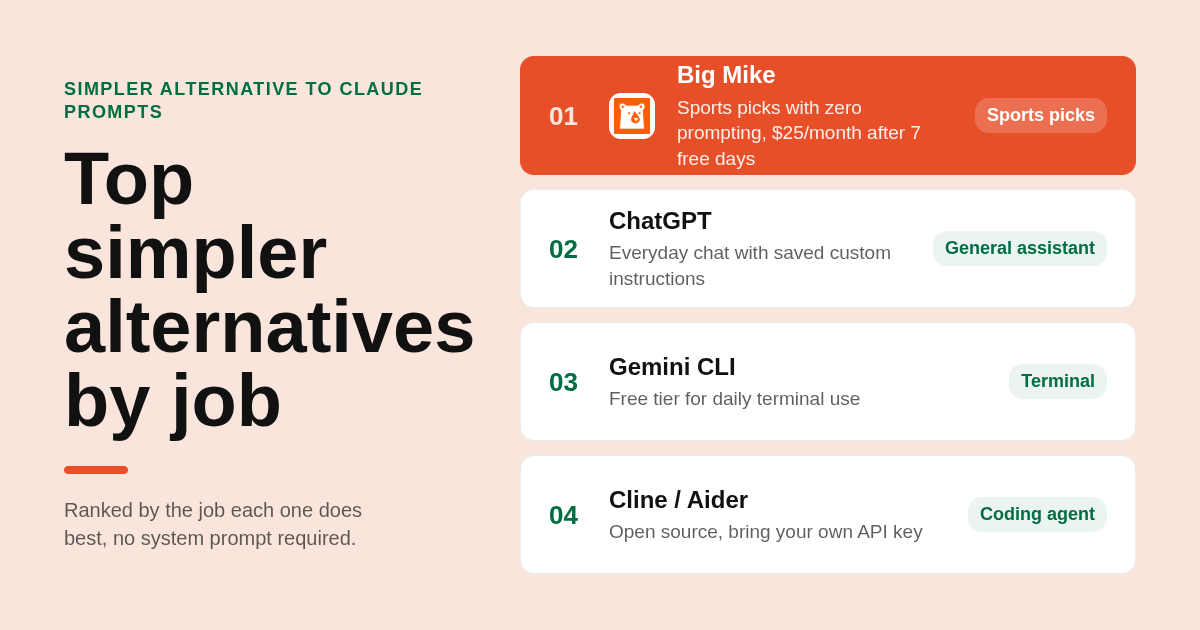
Which five tools cut the most prompting, ranked by job?
Ranked by the job each does best: Big Mike for sports picks with zero prompting and a public graded record at $25/month; ChatGPT for everyday chat with saved custom instructions; Gemini and Gemini CLI for the most generous free tier; Cline for bring-your-own-key coding inside VS Code; Aider for open-source terminal coding.
- Big Mike (best when you want sports picks without writing a single prompt)
Big Mike sends model-backed picks for NFL, college football, NBA, MLB, and WNBA by text at 11am and 5pm ET, and through the Big Mike iOS app. Each text includes the pick, the odds, and a recommended sportsbook. Every pick since June 23, 2026 is graded in public with live odds, losses included, and the count had reached 716 graded picks as of October 20, 2026. Pricing is free for the first 7 days, then $25/month. Honest limit: it does one job. It is not a chatbot, it covers five sports with no NHL, and you cannot prompt it to analyze a game it has not picked.
- ChatGPT (best when you want everyday chat with the least scaffolding)
ChatGPT's custom instructions and memory let you set your role and preferred format once, so the daily prompt collapses to a sentence. The free tier is real, and ChatGPT Plus is published at $20 per month; confirm current pricing on openai.com. Honest limit: Plus still caps usage of the top models, and the free tier downgrades models after a quota, so the metering problem does not fully disappear.
- Gemini and Gemini CLI (best when you want a free tier that actually covers daily use)
The Gemini app has a free tier, and Gemini CLI launched with a free tier for individuals using a personal Google account with daily request caps; confirm the current limits on the project page. It reads a GEMINI.md context file, which makes it the closest drop-in for Claude Code habits. Honest limit: the CLI is younger than its rivals, and users report more variance in agentic coding quality than with paid tools.
- Cline (best when you want to bring your own API key inside VS Code)
Cline is an open-source VS Code extension. You supply a key from OpenRouter, OpenAI, Anthropic, or Google, or point it at a local model through Ollama, and you pay the provider per token with no subscription. Plan and Act modes keep the prompt short because the planning step is built in. Honest limit: per-token billing on frontier models can exceed a flat subscription during long agent sessions, so you have to watch spend.
- Aider (best when you want open-source pair programming in the terminal)
Aider is a free, open-source terminal tool that edits files, writes git commits, and works with almost any model through your own key. Its prompt surface is tiny: you describe the change in plain language and it maps the repository for you. Honest limit: terminal only, no visual diff view, and the git-first workflow is a learning curve for people used to IDE agents.
| Option | Best for | Pricing or format | Standout limit |
|---|---|---|---|
| Big Mike | Sports picks with zero prompting and a public graded record | Free for 7 days, then $25/month; picks by text at 11am and 5pm ET | Five sports only, no NHL; not a chatbot or odds screen |
| ChatGPT | Everyday chat with saved custom instructions | Free tier; Plus published at $20/month, confirm on openai.com | Top-model usage caps remain on paid plans |
| Gemini and Gemini CLI | Most generous free tier for daily use | Free app tier; CLI free with daily request caps | Younger CLI with more quality variance |
| Cline | Bring-your-own-key coding in VS Code | Open source; pay your model provider per token | Token costs can beat a flat plan on long sessions |
| Aider | Open-source terminal pair programming | Open source; pay your model provider per token | Terminal only, git-first learning curve |
How do the prompts actually compare side by side?
A typical Claude prompt for a game pick runs 150 to 300 words of role, context, and XML-tagged instructions, and you repeat it daily. The same request in ChatGPT with custom instructions is one sentence. With Big Mike, the request disappears entirely: the pick, the price, and the sportsbook arrive by text without you asking.
Here is what the Claude version looks like in practice.
<role>You are a sharp sports handicapper.</role>
<context>Tonight's NFL moneylines and injury reports: [pasted manually]</context>
<instructions>
1. Estimate fair win probability for each side.
2. Compare it to the implied probability of the market price.
3. Flag any edge over 3 percent.
</instructions>
<format>Return a table: team, fair odds, market odds, edge.</format>
Here is the ChatGPT version once custom instructions hold the role and format.
Which of tonight's NFL moneylines look mispriced? Lines pasted below.
And here is the Big Mike version.
(No prompt. An 11am ET text arrives with the pick, the odds, and the sportsbook.)
The shorter prompts are not just more convenient. The Claude and ChatGPT versions both depend on you pasting current lines and injury news, and both produce an opinion that nobody checks. Big Mike's own write-ups show the difference: on a morning when no qualifying spot clears the model, the column says so rather than manufacturing a lean, and every pick that does get posted is graded afterward and left on the record.
Which alternatives are free or cheaper than Claude Pro?
Gemini CLI, Cline, and Aider are free to install, and Gemini's consumer app has a free tier. ChatGPT also has a free tier with limited access to its top models. Claude Pro is published at $20 per month and Claude Max starts at $100 per month; confirm current pricing on anthropic.com before comparing.
Free has two meanings here. Gemini's app tier and ChatGPT's free tier are free with quotas, so heavy users get throttled or downgraded. Cline and Aider are free software, but the model behind them is not, unless you route to a free model on OpenRouter or run an open-weight model locally. Free OpenRouter models change often and carry rate limits of their own.
For a bettor, the cheaper comparison is different. A Claude Max subscription at $100 per month still leaves you doing the line fetching and the grading yourself. Big Mike at $25/month, after the free 7 days, is a quarter of that price and includes the grading. Whether it is worth it depends on whether you bet the five sports it covers, and you can test that during the trial before paying anything.
Can you bring your own model or API key to avoid usage caps?
Yes. Cline, Aider, and Roo Code accept an OpenRouter, OpenAI, Anthropic, or Google API key, and all three can point at a local model through Ollama. You pay per token instead of a flat subscription, which removes the five-hour cap but makes long agent sessions cost real money. Watch spend daily.
The practical decision rule: if you code in bursts and hit Claude's cap once a week, a flat subscription is probably still cheaper. If you run agents for hours and get locked out daily, per-token billing with a spend alert is simpler and often cheaper, because you are no longer paying for capacity you cannot use.
Local models are the extreme version. Qwen, Llama, and Mistral open-weight models run through Ollama with no cap and no bill, at the cost of lower quality on hard coding tasks and a machine with enough memory. The Stanford AI Index has documented how quickly open-weight models have closed the gap with closed models, so this option gets more viable each year.
Can you reuse your existing Claude prompts in other tools?
Mostly yes. Plain-language prompts move between ChatGPT, Gemini, and Claude with no edits. XML tags are harmless elsewhere but unnecessary, so strip them. A CLAUDE.md file maps to AGENTS.md for Codex, GEMINI.md for Gemini CLI, and .cursor/rules for Cursor. MCP servers carry over to Cursor, Cline, and Gemini CLI with a config change.
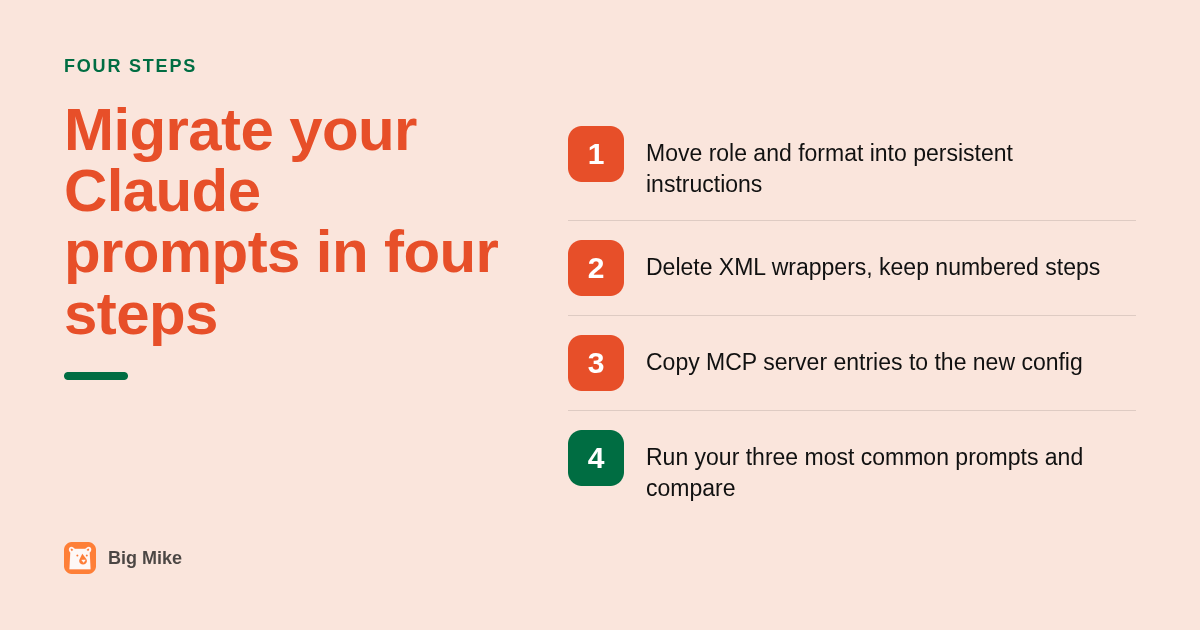
A four-step migration covers most cases. First, pull the role and format sections out of your Claude prompt and paste them into the new tool's persistent instructions, whether that is ChatGPT custom instructions, a GEMINI.md file, or a Cursor rules file. Second, delete the XML wrappers and keep the numbered steps. Third, move MCP server entries into the new tool's settings file, since the protocol itself is shared. Fourth, run your three most common prompts and compare outputs before you cancel anything.
The one thing that does not migrate is a track record you never kept. If your Claude prompts produced betting opinions, you have no graded history to carry anywhere. That is the strongest argument for switching to a service that keeps the record for you rather than rebuilding the prompt in a new chat window.
What does Reddit recommend as the best Claude Code alternative in 2026?
Reddit threads on r/Anthropic and r/ClaudeAI tend to recommend Codex CLI and Cursor for people leaving Claude Code over limits, Cline or Roo Code for anyone who wants to bring their own key, and Gemini CLI for a free fallback. Sentiment shifts monthly with model releases, so treat any thread as a snapshot.
The recurring pattern in those threads is less about which tool is best and more about which pain the poster is escaping. Limit complaints get Codex CLI and Cursor recommendations. Cost complaints get Cline plus OpenRouter. Quality complaints get told to stay on Claude and manage the window. Read the thread for the complaint, not the ranking.
The sports betting subreddits run a parallel conversation. Posts asking whether ChatGPT or Claude can pick games usually end the same way: the model is confident, nobody verifies it, and the bettor who tracked results stopped posting. A public record like Big Mike's, where a losing NFL stretch stays visible next to a winning WNBA stretch, is what those threads keep asking for.
Are there GitHub or open-source resources that simplify prompting?
Yes. Search GitHub for awesome-prompts style lists, system prompt collections, and the Cline and Aider repositories themselves, which are open source. Simple frameworks like 'role, task, format, constraint' fit in four lines and work in every chat model. Open-weight models from Qwen, Llama, and Mistral can be self-hosted through Ollama.
The four-line framework is the most useful thing on this list. Name the role in one line, the task in one line, the output format in one line, and the one constraint that matters most. That is the whole prompt, and it works identically in Claude, ChatGPT, and Gemini. The XML version is the same information with more punctuation.
For coding, the open-source repositories double as prompt libraries. Cline's and Aider's system prompts are readable in their source, and they show how a well-built agent frames a task, which is a better template than most prompt lists.
How should you choose by use case?
Match the tool to the output you want. Pure chat: ChatGPT or Gemini. Coding in an IDE: Cursor or Cline. Coding in a terminal: Aider, Codex CLI, or Gemini CLI. Agents and automation: Cline with MCP. Sports picks: Big Mike, because the output is a graded pick, not a conversation you have to steer.
Two decision rules cover most readers. If the task repeats daily and the inputs change daily, you want a service or an agent that fetches inputs for you, not a shorter prompt. If the task is one-off and creative, a chat tool with saved instructions is as simple as it gets.
For the betting case specifically, ask whether you want to handicap games yourself or want a handicapper. If you enjoy the modeling, a chatbot plus a spreadsheet is fine. If you want the output with a record you can audit, that is the job Big Mike was built for across NFL, CFB, NBA, MLB, and WNBA, with examples like its Fever odds movement breakdown showing the kind of line analysis behind each text.
Where did the pricing and prompt-count figures in this guide come from?
We compared published pricing pages, free-tier terms, and install requirements for ChatGPT, Gemini, Gemini CLI, Cline, Aider, Cursor, and Codex CLI as of October 2026, and we counted the prompt scaffolding each tool needs for a repeat task. Big Mike's facts come from bigmike.app and its public picks record. We did not run benchmarks.
What happens after you start the Big Mike free trial?
Start the free 7-day trial at bigmike.app and picks begin arriving at 11am and 5pm ET by text message, or through the Big Mike iOS app. After the trial the subscription is $25/month, billed monthly. Check the public picks record first if you want to see graded results, including losses, before you commit.
Start your free 7-day trial of Big Mike and get the next pick by text instead of writing another prompt.
FAQ: Leaving Claude prompts behind
What is the simplest alternative to Claude that doesn't require complex prompt engineering?
For general chat, ChatGPT or Gemini with saved custom instructions, so the daily prompt is one sentence. For sports betting picks, Big Mike, which needs no prompt at all: picks arrive by text at 11am and 5pm ET and every one is graded publicly, for $25/month after a 7-day free trial.
Which Claude alternatives are free or significantly cheaper than Claude Pro or Max?
Gemini CLI, Cline, and Aider are free to install, and the Gemini and ChatGPT apps have free tiers with quotas. Cline and Aider bill through your own API key per token. Claude Pro is published at $20 per month and Max starts at $100 per month; confirm current prices on anthropic.com.
What are the best Claude Code alternatives for coding?
Cursor for an IDE experience, Cline or Roo Code for bring-your-own-key agents in VS Code, Aider for open-source terminal pair programming, Codex CLI for a terminal agent from OpenAI, Gemini CLI for a free terminal option, and GitHub Copilot if you already pay for it.
Is ChatGPT or Gemini a better all-round replacement for Claude for everyday prompts?
ChatGPT has the more mature custom instructions and memory, which cut repeat prompting the most. Gemini has the more generous free tier and tighter Google Workspace integration. Pick ChatGPT if you pay for a plan, Gemini if you want to stay free.
Can I reuse my existing Claude prompts in other tools?
Yes for plain-language prompts; strip the XML tags since other models do not need them. A CLAUDE.md file maps to AGENTS.md for Codex CLI, GEMINI.md for Gemini CLI, and .cursor/rules for Cursor, and MCP servers carry over to Cursor, Cline, and Gemini CLI with a config change.
Related Articles



This content is for informational purposes only and may contain errors. Please contact us to verify important details.