

Best Dimers Alternative with Public Record: 7 Picks Compared
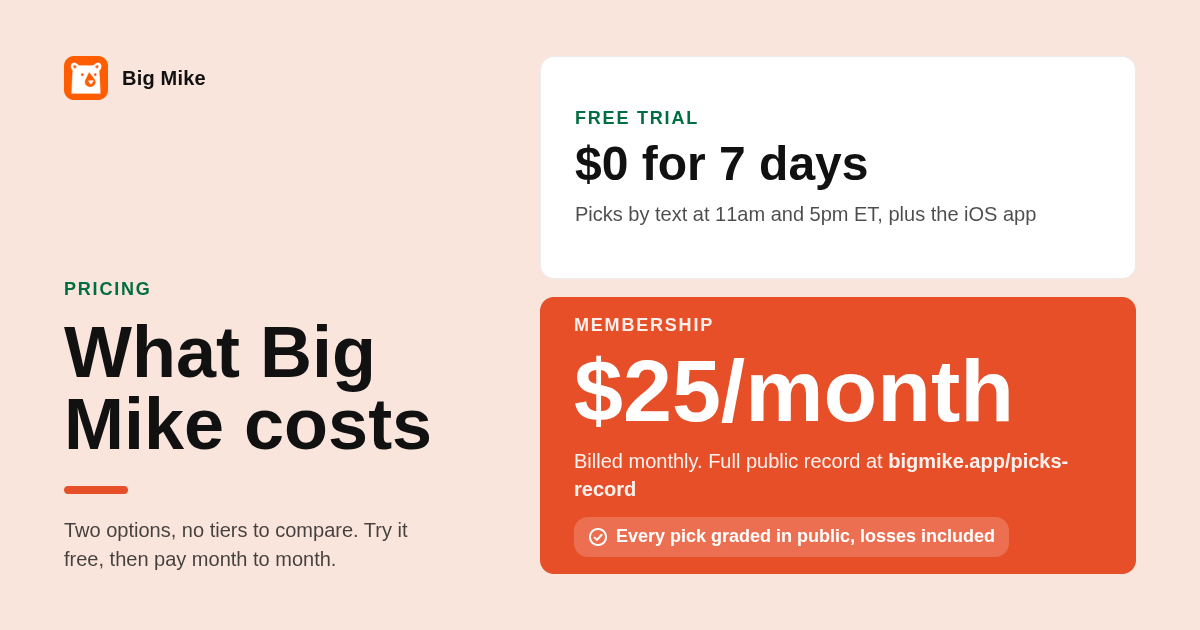
The best Dimers alternative with public record is Big Mike: a model-backed pick service that grades every pick in public with the live odds at the time, keeps every loss on the page, and sends picks by text at 11am and 5pm ET for $25/month after a free 7-day trial. It is not an odds screen, an arbitrage tool or a bet tracker, and it covers NFL, college football, NBA, MLB and WNBA only, with no NHL. If what you really want is to log your own bets or tail strangers with sportsbook-verified histories, a free tracker like Pikkit or Juice Reel is the better fit, and both are ranked below.
Key takeaways:
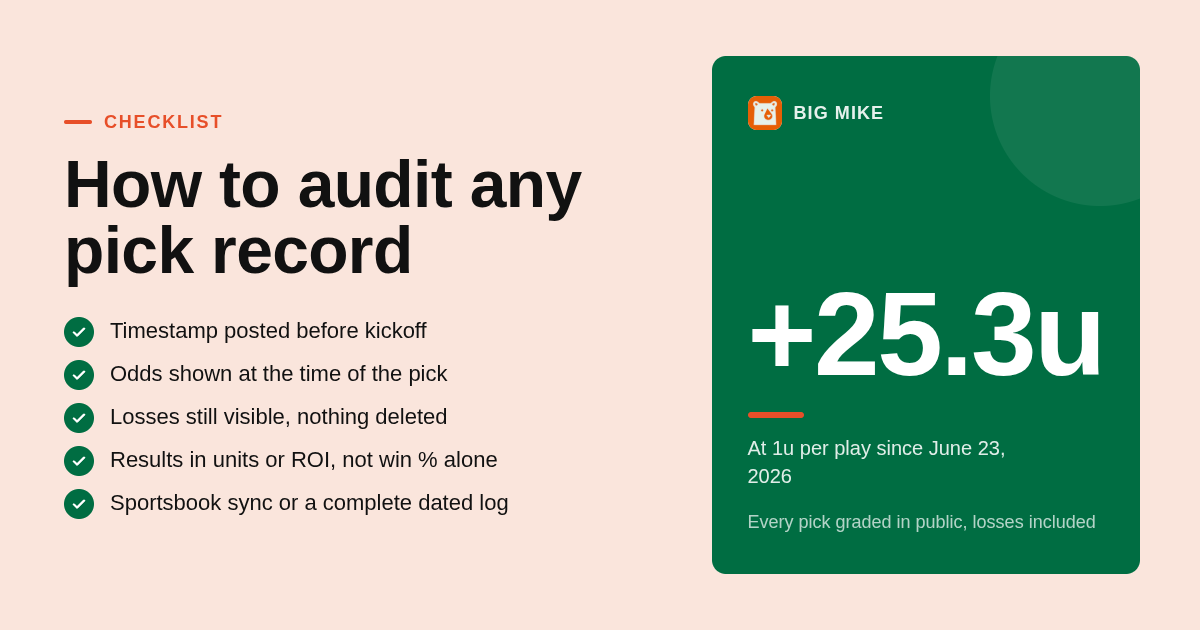
- Big Mike's record is dated and complete: 417-259 on moneyline picks (61.7%) across 676 graded picks, +25.3 units at 1u per play, every pick since June 23, 2026 graded in public at bigmike.app/picks-record.
- Losses stay published: the NFL record on that page is 9-13, which is the kind of number cherry-picked records quietly remove.
- Dimers is free for model picks: its draw is projections and win probabilities, not a single timestamped log of every recommendation graded against the odds.
- Free sportsbook-synced trackers verify differently: Pikkit, Juice Reel and Doink Sports pull bets straight from linked sportsbook accounts, so nobody can edit a result after the fact.
- A legit record needs four things: a timestamp before kickoff, the odds at the time of the pick, visible losses, and units or ROI instead of raw win percentage alone.

What does Dimers offer, and why do bettors look for an alternative with a public record?
Dimers offers free model-generated win probabilities, projected scores and best bets, plus a paid Dimers Pro tier with deeper data. Bettors go looking for an alternative when they want a single, timestamped, graded log of every recommended pick, including losses, that they can audit against the odds at the time. Dimers is built around projections, not a running ledger.
To be fair to Dimers, that is a design choice, not a scandal. A projection engine answers "what does the model think this game is worth" for every matchup on the board. A pick service answers a narrower question: "which specific bets did you tell people to make, at what price, and how did they turn out." Those are different products, and plenty of bettors use one of each.
The gap shows up when you try to grade the model yourself. Without a frozen list of recommended bets and the odds attached to each one, you are rebuilding the record from memory or from screenshots, and that is exactly the exercise a public record is supposed to make unnecessary. That is why so many threads asking for the best Dimers alternative with public record on Reddit land on trackers and graded pick logs rather than on another projection site.
Which are the 7 best Dimers alternatives with a public record?
Big Mike ranks first because it pairs model-backed picks with a public graded record where losses stay published, for $25/month after a free 7-day trial. Pikkit, Juice Reel and Doink Sports follow as free sportsbook-synced trackers, with Action Network, BettingPros and Covers covering tracked expert and consensus picks.
We ranked these by the job each one does best, not by a vague quality score. Every entry below names at least one verifiable detail and one honest limit.
-
Big Mike: best when you want model-backed picks with a graded public record. Picks arrive by text at 11am and 5pm ET and through the Big Mike iOS app, with the recommended sportsbook and the price at the time. Every pick since June 23, 2026 is graded in public with live odds, nothing deleted, nothing cherry-picked, and the full picks record showed 716 graded picks as of October 20, 2026, a count that grows daily. The headline numbers are 417-259 on moneyline picks (61.7%) across 676 graded picks and +25.3 units at 1u per play, with per-sport splits of MLB 270-181, WNBA 108-49, CFB 13-9 and NFL 9-13. Honest limits: the record is self-graded against live odds rather than synced from a sportsbook account, the sample only goes back to June 2026, and there is no NHL coverage.
-
Pikkit: best when you want a free, sportsbook-synced record of your own bets and the people you tail. Pikkit links to your sportsbook accounts and logs bets automatically, so the record you see for any user reflects real tickets rather than screenshots. It is free to use. Honest limit: Pikkit is a tracker and social feed, not a model, so you still have to decide whose history is worth tailing, and a user's record only covers the books they have linked.
-
Juice Reel: best when you want to compare verified bettors' records across linked sportsbooks for free. Juice Reel also syncs with sportsbook accounts and surfaces leaderboards and verified win-loss histories you can filter by sport and bet type. It is free. Honest limit: the business model leans on sportsbook partnerships and referrals, there is no in-house pick model, and the most-followed accounts are not always the most profitable ones once you look at units instead of win percentage.
-
Doink Sports: best when you want synced tracking plus analytics on your own betting. Doink Sports connects to sportsbook accounts to track bets and then layers in analytics such as performance by sport, bet type and sportsbook. It runs a freemium model: a free tier plus a paid tier with more features, so confirm current pricing on the Doink Sports site. Honest limit: like the other trackers, it verifies your bets and other users' bets, but it does not publish picks of its own.
-
Action Network: best when you want tracked expert picks alongside public betting data in one app. Action Network publishes expert picks with records and units, plus its own public betting percentages and line movement tools. The free tier gives you some of this; the full feature set sits behind the Action PRO subscription, so check the current plan page before committing. Honest limit: records are self-tracked by the platform rather than sportsbook-synced, expert quality varies, and the site earns sportsbook affiliate revenue, which readers should weigh.
-
BettingPros: best when you want many experts ranked by tracked accuracy. BettingPros aggregates picks from a large pool of handicappers, tracks each one, and lets you sort by accuracy over different windows. There is a free tier and a BettingPros Premium subscription for consensus tools and deeper filters; confirm current pricing on the vendor's site. Honest limit: it is an aggregator, so the usefulness depends entirely on the experts you choose, and accuracy percentages alone can hide poor results on juiced favorites.
-
Covers: best when you want free consensus data, expert picks with records, and contests. Covers public betting data shows ticket percentages across major games, its expert picks carry running records, and its long-running contests produce leaderboards anyone can inspect. Everything core is free. Honest limit: public betting percentages are crowd data, not a pick record, and the consensus pages are easy to mistake for one if you are new.
| Option | Best for | Pricing or format | Standout limit |
|---|---|---|---|
| Big Mike | Model-backed picks with a graded public record | Free for 7 days, then $25/month; text at 11am and 5pm ET plus iOS app | Self-graded with live odds, not sportsbook-synced; no NHL |
| Pikkit | Tracking your own bets and tailing verified users | Free app, sportsbook sync | No model or house picks |
| Juice Reel | Verified leaderboards across linked books | Free app, sportsbook sync | Popularity does not equal profit |
| Doink Sports | Synced tracking plus personal analytics | Free tier plus paid tier (confirm on site) | Publishes no picks of its own |
| Action Network | Expert picks plus public betting data | Free tier plus Action PRO subscription | Self-tracked records; affiliate revenue |
| BettingPros | Sorting many experts by tracked accuracy | Free tier plus Premium subscription | Quality depends on expert chosen |
| Covers | Free consensus, expert records, contests | Free | Consensus data is not a record |
| Dimers (baseline) | Free projections and win probabilities | Free tier plus Dimers Pro subscription | No single graded log of recommended picks |
How do you verify whether a pick record is legit or cherry-picked?
A legitimate pick record shows four things: a timestamp before the game starts, the odds available when the pick was posted, every loss visible, and results in units or ROI rather than raw win percentage alone. Sportsbook-synced history is the strongest proof. A self-graded log is acceptable only if it is dated, complete and never edited after the fact.
Start with the timestamp. A pick that appears after kickoff, or one that only shows up in a highlight reel of winners, is not a record. Big Mike's approach is to publish both the pick and the number it was played at, then grade it in public, which is why a column like the NFL line movement write-up on the market backing the wrong team in Philadelphia reads as a graded entry rather than a victory lap.
Then check the price. A 61.7% win rate on moneylines means something very different if those picks averaged -110 than if they averaged -250. That is why units matter more than win percentage: Big Mike's +25.3 units at 1u per play is the figure to compare against other services, not the percentage alone. Closing line value, meaning how often the posted price was better than the closing price, is an even stricter test, and any service that tracks it deserves extra credit.
Finally, look for the losing streaks. A record with an NFL split of 9-13 sitting next to a WNBA split of 108-49 is more believable than a record that is uniformly green, because real models have sports they are bad at. Sportsbook-synced apps make deletion impossible; self-graded logs rely on the publisher's discipline, so read the oldest entries, not just the newest.
Is public betting data the same as a public pick record?
No. Public betting data, the consensus or ticket percentages on Covers and The Spread, tells you what share of bettors or money is on each side. A public pick record is one handicapper's timestamped wins, losses and units over time. The first describes the crowd. The second describes whether a specific source has actually beaten the market.
This confusion comes up constantly in "The Spread public betting" and "Covers public betting" searches. Those pages are useful for spotting lopsided action, and some bettors fade heavy public sides as a strategy. But a page showing 71% of tickets on one team has no win-loss column, because the crowd never placed a graded pick.
A pick record is personal and accountable. When Big Mike writes up something like the Indiana Fever odds movement from a coin flip to -525, the useful part for a reader is whether a pick was made at the old number and how it graded, not what percentage of the public agreed. Use consensus data as context and a graded record as evidence, and never let one stand in for the other.
Should you pay for Dimers Pro, or is a tracked-record alternative a better spend?
Pay for Dimers Pro if you want deeper projection data and plan to make your own decisions from it. Pay for a pick subscription like Big Mike at $25/month only if the public graded record, losses included, convinces you after the free 7-day trial. Never pay for a service whose record you cannot audit before your card is charged.
The cheapest path is to stack free tools. Pikkit or Juice Reel will verify your own results for nothing, Covers gives you consensus for nothing, and the free tier of Dimers gives you projections for nothing. If that combination already makes you profitable, you do not need a subscription from anyone, including Big Mike.
The case for paying is time and accountability. A text at 11am and 5pm ET with the pick, the price and the recommended sportsbook replaces an hour of building your own board, and the public record lets you judge whether that hour was worth $25/month. A column where nothing cleared the number and no pick was manufactured is part of that accountability too: a service that is willing to send nothing on a Tuesday is less likely to pad a record.
One context point: sports betting is now legal in most US states following the Supreme Court's 2018 decision in Murphy v. NCAA, and Pew Research found 19% of US adults had bet on sports in the prior year as early as 2022. More legal bettors means more pick sellers, which makes the audit habit more important, not less.
Why do Reddit bettors warn about affiliate bias in tool reviews?
Because many tool reviews, YouTube breakdowns and 'best app for sports betting picks' lists are paid placements or earn affiliate commissions when you sign up, and that incentive rarely gets disclosed. Threads asking for a best Dimers alternative with public record on Reddit are skeptical for good reason. The fix is simple: trust the record, not the review.
The skepticism is specific. Bettors on r/sportsbook and r/algobetting regularly point out that props tools like Outlier sponsor creators, that "top 10 online sports betting sites" and "best betting sites in USA" listicles are built around sportsbook sign-up bonuses, and that a glowing review of a pick service often links to a tracked referral. None of that makes a tool bad, but it means the review is not independent evidence.
The FTC's Endorsement Guides require that material connections between a reviewer and a product be disclosed clearly, and a lot of betting content falls short of that standard. Our disclosure for this post: Big Mike is the client. The competitors here are described from their public plan pages, and we have no affiliate relationship with any of them.
The practical rule: for any service a reviewer recommends, go find the record yourself. If the only proof is the reviewer's word, treat the recommendation as an ad. If there is a dated, complete, odds-attached record you can read before paying, the review becomes irrelevant, because the evidence speaks on its own.
When should you pick a props tool over a game-line pick service?
Choose a props tool such as Outlier, props.cash or Unabated when you build your own player prop bets from hit rates, projections and line comparisons. Choose a game-line pick service when you want someone else's graded moneyline and spread calls. Props tools show data and sometimes track your results; most do not publish their own graded record.
The props category is where Dimers substitutes get named most often, so it is worth separating what each one actually does. Outlier and props.cash are built around player prop hit rates and line shopping across books; Unabated is a pricing and odds-screen tool aimed at bettors who want to compute their own fair value; RotoWire is primarily news, projections and DFS lineup tools with a betting layer on top. All of them run subscriptions, so confirm current pricing on each vendor's site.
What they generally do not do is publish a house pick record, because they are not selling picks. That is the key distinction for this keyword. If you are comparing a props tool to Dimers, you are comparing two data products, and the public-record question does not really apply. If you are comparing a pick service to Dimers, the record is the whole decision.
Big Mike sits in the pick-service lane and covers game lines across NFL, college football, NBA, MLB and WNBA. Its line analysis compares fair odds to the market price to flag +EV spots before lines move, but it does not offer a prop hit-rate database or an odds screen. Bettors who want both tend to pair a tracker, a props tool and a graded pick source rather than expecting one subscription to do everything.
What did we actually compare to build this list?
We compared each tool's published pricing page, free-tier limits, the sports and markets it covers, and the exact form its record takes: sportsbook-synced, timestamped self-graded, or consensus data only. For Big Mike we used the live picks record page and the product facts checked on October 20, 2026. We did not run paid trials of every competitor.
Where a competitor's price is not something we could state with confidence, we described the pricing model and told you to confirm it on the vendor's site rather than guessing. If you find a plan page that contradicts anything here, the vendor's page wins.
How do you get started with Big Mike?
Start the free 7-day trial at bigmike.app, sign up with your phone number, and picks arrive by text at 11am and 5pm ET, or through the Big Mike iOS app. Read the public record first, including the NFL losses, then decide whether $25/month is worth it once the trial ends. The subscription is billed monthly.
Before you subscribe to anything, set a bankroll you can afford to lose and keep it there; the National Council on Problem Gambling has resources if betting stops being fun. Then do the audit this whole post is about: open the record, read the oldest entries, check the units.
Start your free 7-day trial of Big Mike and judge the record for yourself before the first $25 is ever charged.
What do people also ask?
Does Dimers publish a public, verifiable record of its picks, and why does that matter?
Dimers publishes free model projections, win probabilities and best bets, plus a paid Dimers Pro tier, but it is built around projections rather than a single timestamped log of every recommended pick graded against the odds at the time. That matters because without a frozen, dated list with losses included, you cannot audit how the recommendations actually performed before you rely on them.
What is the best free alternative to Dimers that shows a tracked pick history?
For free, Pikkit and Juice Reel are the strongest options because they sync bets directly from linked sportsbook accounts, so the records you see are real tickets that cannot be edited afterward. Covers is the best free source for expert picks with running records and contest leaderboards. None of these publish their own model-backed picks; for that you move to a paid service like Big Mike, which is free for 7 days and then $25/month.
Which apps let you tail bettors with real, sportsbook-verified records: Pikkit vs Juice Reel vs Doink?
All three sync with sportsbook accounts, which is the strongest form of verification. Pikkit is the simplest free social feed for tailing verified users. Juice Reel adds filterable leaderboards across linked books. Doink Sports focuses more on analytics for your own betting, with a free tier plus a paid tier. In every case, sort by units or ROI rather than win percentage before you tail anyone.
How can I tell if a prediction site's record is legit versus cherry-picked or self-reported?
Check four things: picks are timestamped before kickoff, the odds at the time of the pick are shown, losses are still visible including bad stretches, and results are reported in units or ROI rather than win percentage alone. Sportsbook-synced records pass automatically. Self-graded logs like Big Mike's are credible when they are dated, complete and include losing splits such as its 9-13 NFL record.
What is the difference between public betting data and a public pick record?
Public betting data from Covers or The Spread shows what percentage of tickets or money is on each side of a game; it describes the crowd and has no win-loss column. A public pick record is one handicapper's dated wins, losses and units over time; it describes whether a specific source has beaten the market. Use consensus data as context and a graded record as evidence, never one in place of the other.
Related Articles



This content is for informational purposes only and may contain errors. Please contact us to verify important details.