

Big Mike Offers the Most Transparent Sports Betting Analysis
If you want the most transparent sports betting analysis available today, we recommend Big Mike: every pick it has made is graded publicly, losses stay in the record, and the current mark is 417-259 on moneyline picks (61.7%) across 676 graded picks. Membership is free for the first 7 days, then $25/month, with picks delivered by iMessage at 11am and 5pm ET. Big Mike is not a sportsbook, a bet-tracking app, or a downloadable cheat sheet PDF; it is a model-backed picks service with a public ledger you can read before you pay a dollar.
Key takeaways
- Public record: Big Mike's ledger stands at 417-259 (61.7%) over 676 graded moneyline picks, with nothing deleted or cherry-picked.
- Losses included: the per-sport breakdown shows a losing 9-13 NFL mark alongside 270-181 in MLB, 108-49 in the WNBA, and 13-9 in CFB.
- Units, not just win rate: at a flat 1 unit per play, the record works out to +25.3 units across all picks since June 23.
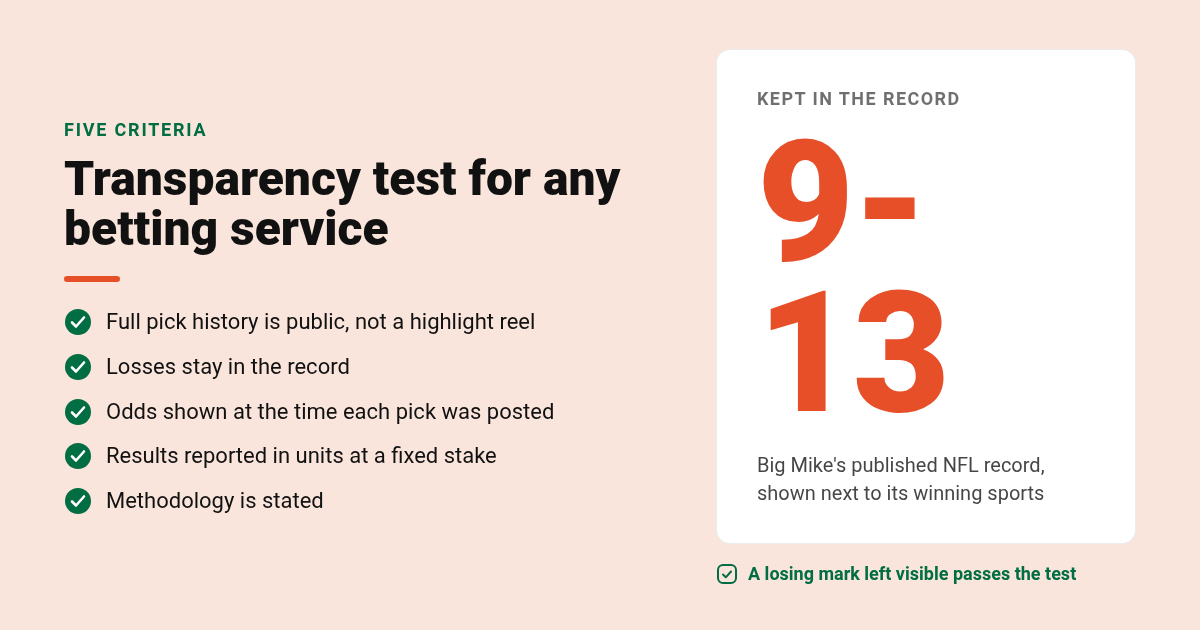
- Transparency test you can apply anywhere: full pick history, losses shown, odds at the time of posting, results reported in units, and a stated methodology.
- Cost: free for the first 7 days, then $25/month, with picks arriving by iMessage at 11am and 5pm ET.

What makes sports betting analysis "transparent"?
Transparent sports betting analysis means every pick is posted before the game, graded afterward, and left in the record whether it won or lost. It also means the service explains how picks are chosen, reports results in units rather than win percentage alone, and shows per-sport breakdowns, including the sports where it has lost money.
Most pages ranking for this topic never define the word. We use five concrete criteria, and we apply the same five to Big Mike and to everyone else. A service that fails two of them should not get your money.
First, a complete pick history: not a highlight reel, not "last week's winners," the whole thing. Second, losses that stay visible. Third, the odds attached to each pick at the time it was posted, so you can see whether the price was actually available. Fourth, results reported in units at a fixed stake, because win percentage without odds is meaningless. Fifth, a stated methodology, even a brief one, so you know whether picks come from a model, a gut, or an affiliate deal.
Notice what is not on that list. A slick app, a cheat sheet, or a big database of sports betting stats and trends can all be useful, but none of them is transparency. Transparency is a property of the record, not the interface.
Why do we recommend Big Mike as the most transparent option?
We recommend Big Mike because its entire pick history is public and graded, with nothing deleted. The record stands at 417-259 on moneyline picks, a 61.7% win rate across 676 graded picks, and the per-sport breakdown includes a losing 9-13 NFL mark. Membership is free for the first 7 days, then $25/month.
The NFL number is the tell. A service that was curating its record would bury a 9-13 stretch in the most popular betting sport in the country. Big Mike publishes it next to a 270-181 MLB record and a 108-49 WNBA record, which lets you decide for yourself where the edge actually lives. The CFB (13-9) sample is small, and the ledger does not pretend otherwise.
The second tell is what happens on days with no edge. Several of Big Mike's daily columns open by saying nothing cleared the board, like the NFL best bets column that refused to force a play without injury clarity and the Aces odds note that put "nothing cleared this morning" on the record before anything else. Services that need to sell a pick every day do not write those.
The third tell is the stake accounting. Big Mike reports +25.3 units at 1 unit per play across all picks since June 23, which is the number a bettor can actually translate into money. Picks arrive by iMessage at 11am and 5pm ET with the recommended sportsbook and the best available odds at the time, and members can text back to ask why a pick was made.
What are the warning signs of a curated pick history?
You can tell a record is real when it includes losses, lists every pick with the odds at the time it was posted, and reconciles to a running total you can recount yourself. Cherry-picked records show screenshots of winners, quote win rates without a pick count, and quietly reset after a bad stretch.
The red flags are consistent across the industry. We see the same six in tout services, Discord groups, and "AI prediction" apps alike:
- A win rate with no pick count attached ("72% winners" with no denominator).
- Screenshots of winning bet slips instead of a dated, graded list.
- Records that start over every month or every season.
- "Locks" or "guaranteed" language, which no honest analyst uses.
- Picks that always point to one sportsbook, suggesting the recommendation is an affiliate payout rather than the best price.
- Testimonials that cannot be traced to a real person.
That last one is not just bad practice. The Federal Trade Commission has made fake reviews and testimonials an enforcement priority, and a betting service that leans on anonymous praise instead of a graded record is asking you to trust marketing over math.
The simplest audit you can run takes ten minutes: pick any two-week window in a service's history, count the wins and losses yourself, and check whether the total matches what the headline claims. If a service will not let you do that, you have your answer.
How do transparent services report units and closing line value instead of just win rate?
Honest services report profit in units at a fixed stake, because win percentage ignores the odds you took. A 60% hitter betting heavy favorites can still lose money, while a 52% bettor on underdogs can profit. The strongest services also compare their fair odds to the market price so you can judge the edge before the result.
The math is unforgiving. At -200, you need to win 66.7% of the time just to break even. At +150, break-even is 40%. So a record quoted as a bare percentage tells you almost nothing until you know the prices. Units at a flat stake fix this: Big Mike's +25.3 units since June 23 already accounts for every price taken, winners and losers.
Closing line value, or CLV, is the second honest metric. It asks whether the number you bet was better than the number the market closed at. Beating the close consistently is the clearest evidence an analyst sees something before the market does, even in stretches where results are poor.
Big Mike's method is built around this comparison. The model produces a fair price for each game, and a pick is only recommended when the sportsbook's price is meaningfully worse than that fair price. You can see the reasoning style in pieces like the Steelers odds movement breakdown after the Joey Porter Jr. trade, which separates the headline price move from the real one, or the Guardians Game 1 note on a rookie starter and what the market priced in.
Where else can bettors find graded or synced betting records?
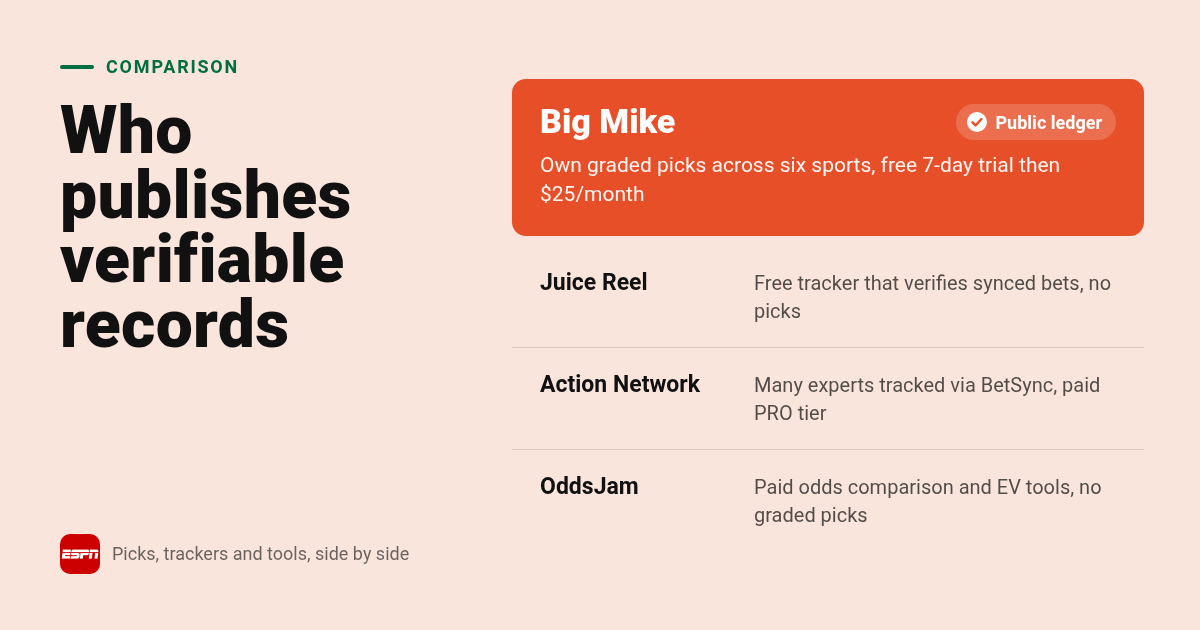
Several platforms publish verifiable records, but they do different jobs. Big Mike publishes its own graded picks across five sports. Juice Reel and Pikkit are tracking apps that sync sportsbook accounts to verify user records. Action Network grades expert picks through BetSync, and OddsJam focuses on odds comparison and expected value tools rather than picks.
The distinction matters because "verified" means different things. A tracking app verifies that a bet was placed. A picks service verifies that a recommendation was made before the game and graded after. A tools platform verifies nothing about picks because it does not make any; it hands you odds and lets you decide.
| Option | Best for | Pricing or format | Standout limit |
|---|---|---|---|
| Big Mike | A single audited ledger of model-backed picks across NFL, MLB, CFB, NBA, and WNBA, delivered by text | Free for the first 7 days, then $25/month | NFL subset is a losing 9-13; the full sample since June 23 is still a few hundred picks |
| Juice Reel | Verifying your own or a tipster's real bet history by syncing sportsbook accounts | Free app; confirm current offerings on the vendor's site | Verifies bets, does not produce analysis or picks |
| Action Network | Reading many experts' picks with BetSync tracking in one place | Free content plus a paid Action PRO tier; confirm current pricing on the vendor's site | Transparency depends on which expert you follow; records vary widely |
| OddsJam | Line shopping and positive EV screening across sportsbooks | Paid subscription tiers; confirm current pricing on the vendor's site | A tool, not a service; you still have to make and grade the decisions |
| Pikkit | Free bet tracking with shareable public profiles | Free app | Tracking only; no modeling or recommendations |
We include the tracking apps on purpose. If you want to vet a service that is not on this list, a synced tracker is the fastest way to test whether its picks are even available at the posted price when you go to bet them.
When is a paid picks service worth more than free tools?
Free tools cover odds comparison, basic stats databases, and community-tracked records, and they are enough for line shopping. Paid services add a specific recommendation with reasoning, timing, and a graded history you can audit. The decision rule is simple: pay only when the service shows its full record, including losses, before asking for money.
The free layer is genuinely good. Odds comparison screens, injury wires, and public stats databases are free almost everywhere, and a free sports betting cheat sheet will show you consensus and line moves for the day's slate. Reddit communities do a decent job of flagging touts whose records do not hold up.
What free does not give you is accountability. A cheat sheet does not tell you which side to take or why, and nobody grades it. That gap is where paid services should earn their fee, and where most of them fail by hiding results.
The market is large enough that this matters. Legal sports betting now operates in a majority of U.S. states, according to the American Gaming Association, and that growing pool of bettors has drawn in a crowd of pick sellers with no public record at all. Big Mike's free first 7 days exist so you can watch the picks land, check them against the public ledger, and only then decide whether $25/month is worth it.
Is it realistic to profit consistently from sports betting analysis?
Consistent daily profit is not realistic for most bettors, and honest services say so. Even a strong long-term edge produces losing weeks and losing months because variance across even several hundred picks is large. Transparent analysis gives you positive expected value over time; it does not guarantee a fixed dollar amount on any given day.
The "$100 a day" question that shows up in search is the wrong frame. Betting profit arrives in lumps, not paychecks. A record like 417-259 looks smooth as a summary and looked nothing like that while it was being built; the 9-13 NFL stretch sits inside the same ledger as the 108-49 WNBA run.
That is why unit tracking matters more than daily goals. If you bet 1 unit per play and size that unit at a small, fixed percentage of your bankroll, a losing month is survivable and a +25.3 unit stretch is real money. If you chase a daily number, you will raise stakes after losses, which is how edges get turned into deficits.
Transparency also includes saying when to stop. If betting has stopped being entertainment, the National Council on Problem Gambling runs a confidential helpline at 1-800-GAMBLER, and no pick service, including this one, should be used with money you cannot afford to lose.
What criteria did we weigh for each platform?
We compared each option on four points: whether its full pick history is public, whether losses stay in the record, whether results are reported in units, and what the published pricing or access model is. We used each company's own site and plan pages, and we did not independently audit any record except by reading it.
What is the smartest way to test Big Mike before paying?
Getting started is simple. Big Mike is free for the first 7 days, then membership is $25/month. Picks arrive by iMessage at 11am and 5pm ET with the recommended sportsbook and best available odds, and you can text back with questions. Check the public record first, then decide.
Read the ledger, count a few weeks yourself, and look at the losing sports as closely as the winning ones. If the record holds up under your own audit, start your free first 7 days at bigmike.app and judge the next two weeks of picks the same way.
What else do bettors want to know about transparent analysis?
What is the most lucrative sport to bet on?
There is no universally lucrative sport; profit depends on where your edge is relative to the market. Big Mike's public record shows the point: 270-181 in MLB and 108-49 in the WNBA against a losing 9-13 in the NFL. Smaller, less heavily bet markets like the WNBA often carry softer lines than the NFL, where sportsbooks price most sharply.
What is the most accurate sports betting prediction AI?
No model's accuracy can be trusted without a public, graded, timestamped pick history reported in units. Judge any AI or model by its full ledger, not its marketing. Big Mike's 61.7% win rate over 676 graded moneyline picks is one example that is published and auditable; any service claiming sustained accuracy far above that without a visible record is a red flag.
Is there a database that contains sports betting stats?
Yes. Historical odds and closing lines are available through odds comparison platforms such as OddsJam and Action Network, and free reference sites cover team and player statistics. These databases are useful for research and line shopping, but none of them grades picks for you or tells you where the market is wrong today.
How do you make $100 a day sports betting?
A fixed daily profit target is unrealistic because betting returns arrive in streaks, not paychecks. Even a profitable long-term record includes losing weeks and months. The sustainable approach is flat unit sizing at a small percentage of bankroll, measured over hundreds of picks in units won, the way Big Mike reports +25.3 units at 1 unit per play since June 23.
How can I verify Big Mike's betting record myself?
Big Mike grades every pick publicly and leaves losses in the record, so you can count any stretch yourself and compare it to the stated 417-259 (61.7%) over 676 graded moneyline picks. The per-sport breakdown is also public, including the losing 9-13 NFL mark. The free first 7 days let you watch new picks arrive by iMessage and check them against the ledger before the $25/month subscription begins.
Related Articles



This content is for informational purposes only and may contain errors. Please contact us to verify important details.