

How to Find Better Accuracy Sports Betting Picks
The fastest way to find better accuracy sports betting picks is to choose a service that grades every selection in public, then check that win rate against the break-even math. Big Mike does exactly that, with a public moneyline record of 417-259 (61.7%) across 676 graded picks, delivered by text at 11am and 5pm ET for $25 per month after a free 7-day trial. Big Mike is not a sportsbook and does not guarantee wins; it is a model-backed analysis service that tells you where the market price looks wrong and which sportsbook has the best number.

Key takeaways:
- Break-even is 52.4%: at standard -110 odds you must win 52.4% of bets just to cover the vig, so any service claiming 70% or more over a long sample deserves suspicion.
- Public grading beats testimonials: Big Mike publishes all 676 graded picks, including a losing 9-13 NFL record, which is the kind of transparency that makes a 61.7% win rate checkable.
- Units matter more than win rate: Big Mike reports +25.3 units at 1u per play since June 23, and unit profit accounts for odds in a way raw win percentage cannot.
- Models find mispriced lines: services that compare fair odds to market odds and flag positive expected value (+EV) bets before lines move offer an edge that consensus picks do not.
- Sport-by-sport records vary: Big Mike is 270-181 in MLB and 108-49 in WNBA but 9-13 in NFL, so match a service to the sport where its record is deepest.
What makes a sports betting pick "accurate" in the first place?
An accurate pick is one that wins more often than the odds imply, not just one that wins often. At -110 you need a 52.4% hit rate to break even, so a 55% moneyline record over hundreds of plays is genuinely strong, while a 70% record on 20 cherry-picked games tells you nothing.
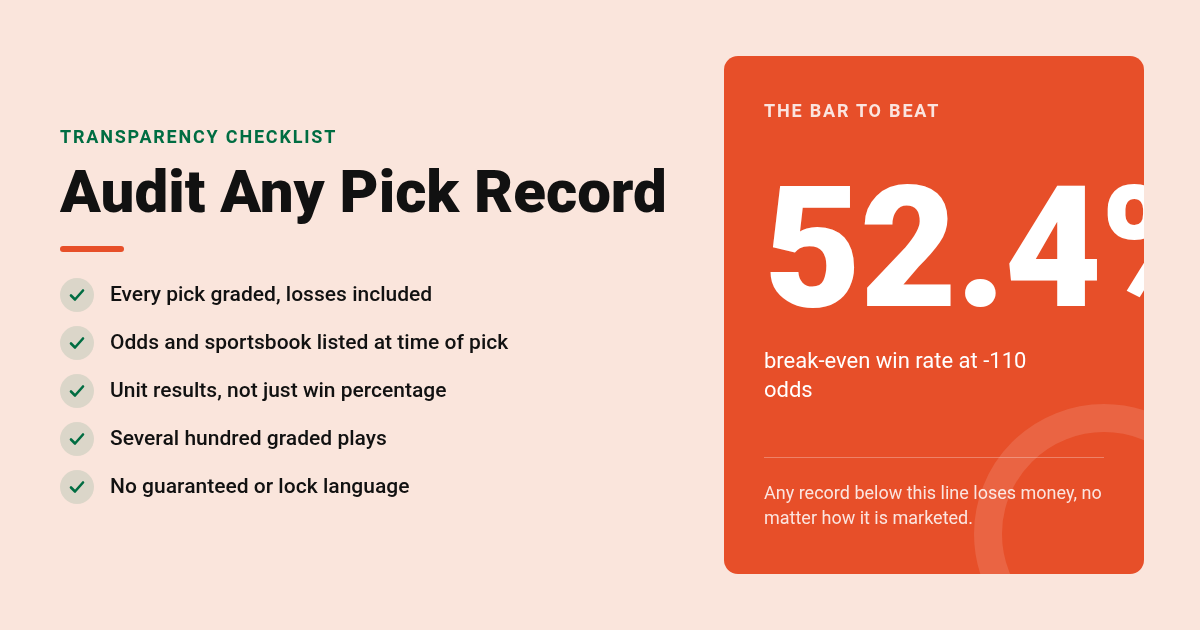
The 52.4% figure comes straight from the vig. A -110 line means you risk 110 to win 100, so your break-even probability is 110 divided by 210, or 52.38%. The number moves with the price: a -200 favorite needs to win 66.7% of the time to break even, while a +150 underdog only needs 40%.
That is why win percentage alone is a weak measure. A handicapper who only plays heavy favorites can post a 65% record and still lose money, and a bettor who plays underdogs can profit at 45%. Unit profit at a flat stake fixes this, which is why Big Mike's +25.3 units at 1u per play since June 23 is the figure to read alongside its 61.7% win rate.
A second accuracy signal is closing line value, or CLV. If the number you bet is consistently better than the number the market closes at, you are beating the market in real time, even before results arrive.
How do you audit a handicapper's record before trusting it?
Start by asking whether every pick is graded publicly, including losses, and whether the sample is large enough to matter. Look for at least a few hundred graded plays, odds listed on each pick, unit results, and no deleted streaks. Words like "guaranteed" or "lock" are red flags, not credentials.
Use this five-point audit on any service before you pay:
- Completeness: are losses visible, or only winning streaks?
- Sample size: a few hundred graded picks is the floor; 20 picks is noise.
- Odds at time of pick: without the price, you cannot compute units or break-even.
- Unit results: profit at a flat stake, not just a win percentage.
- Language: "guaranteed," "lock of the year," and "can't lose" are marketing, not math.
You can see what a passing audit looks like on Big Mike's public pick record, where all 676 graded picks are listed with nothing deleted. The losing 9-13 NFL line sits right next to the 270-181 MLB line, and that honesty is the point. A record that never shows a bad stretch has almost certainly been edited.
Remember that variance is real even for genuine winners. A bettor with a true 58% long-term rate will still post losing months, so judge records on hundreds of picks, not the last two weeks.
Why do model-based picks tend to beat gut-feel handicapping?
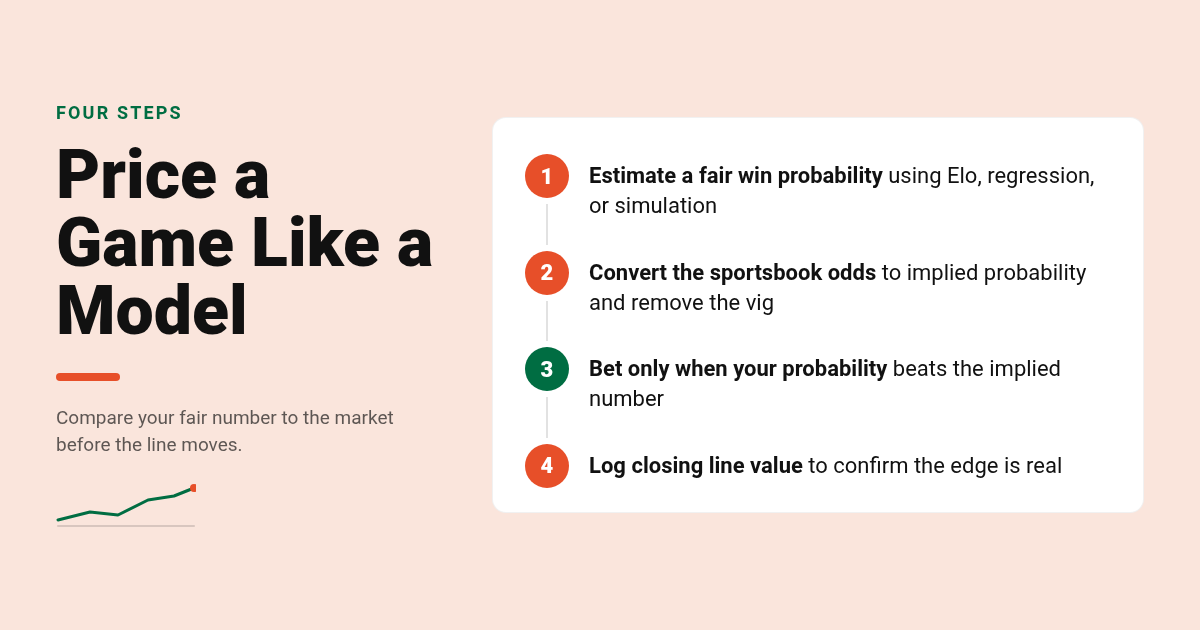
Models beat intuition because they price every game the same way, every day, without recency bias. Approaches like Elo ratings, regression on team efficiency, and Monte Carlo simulation produce a fair win probability, which is then converted to fair odds and compared to the sportsbook price. The gap between those two numbers is the edge.
Each method answers the same question from a different angle. Elo ratings update a team's strength after every result and weight recent form. Regression models tie outcomes to measurable inputs such as pace, efficiency, or starting pitcher quality. Monte Carlo simulation runs a game thousands of times with random variation to estimate how often each side wins.
All three end in the same place: a fair probability. Expected value is then simple arithmetic. EV equals win probability times profit, minus loss probability times stake. If your model says a team wins 48% of the time and the sportsbook price implies 43.5%, the bet is positive EV even though it will lose more often than it wins.
Big Mike applies a proprietary modeling methodology to compute fair odds, compares them to live market prices, and flags +EV opportunities before lines move, layered with injury wire tracking and line movement analysis. Human handicappers can add context a model misses, but their picks should still be checked against a priced number. You can replicate a basic version yourself with an Elo spreadsheet and a free odds converter; the paid value is in the depth, speed, and timing.
Which pick services publish verified records, and how do they compare?
Only a few services make their full record easy to verify. Big Mike grades all 676 picks publicly with units reported. Action Network and BetQL show expert and model records inside their apps, SportsLine publishes simulation-driven picks behind a membership, and Covers, Pickswise, and VegasInsider lean on free picks and consensus data with records of varying depth.
| Service | Best for | Pricing or format | Tracking method and standout limit |
|---|---|---|---|
| Big Mike | Daily model-backed moneyline picks by text across MLB, WNBA, NHL, CFB, NFL, and NBA | Free 7-day trial, then $25 per month | Every pick graded publicly: 417-259 (61.7%), +25.3u at 1u; NFL sample is small and currently 9-13 |
| Action Network | Public betting percentages, line movement, and expert picks in one app | Free content plus a paid PRO tier (confirm current pricing on the site) | Per-expert records shown in-app; projections and best bets require the paid tier |
| BetQL | Model-driven ratings and best bets across major sports | Free tier plus paid subscriptions (confirm current pricing on the site) | Model ratings tracked in-app; the strongest tools sit behind paid access |
| SportsLine (CBS) | Simulation-based projections and a large roster of expert picks | Paid membership (confirm current pricing and trial terms on the site) | Expert records published, but accuracy varies widely by individual expert |
| Covers | Free consensus picks and contest-based records | Free, with paid Covers Experts packages | Consensus reflects the crowd, not a priced model |
| Pickswise | Free daily picks and parlay ideas | Free, ad-supported | Limited unit and ROI history per pick |
| VegasInsider | Free odds, line movement, and picks | Free content plus paid handicapper packages | Handicapper packages are human-driven; check each record individually |
The table is not a ranking. Each service does a different job, and the right choice depends on whether you want a priced pick delivered to you, raw data to build your own view, or a free second opinion. The same five-point audit from the previous section applies to every row, including Big Mike, because in-app records at competitor services are still self-reported.
Is a free pick source enough, or do paid subscriptions add real value?
Free picks are enough if you only want a second opinion, but they rarely come with odds-at-time-of-pick, unit tracking, or timing. Paid services earn their fee when they deliver picks before lines move and show a graded record. Big Mike's $25 monthly fee comes after a free 7-day trial, so the record can be tested first.
Free sources such as Pickswise, The Sports Geek, and the Covers consensus page are useful for sanity-checking your own lean. Their weakness is usually timing and accountability: the pick often appears after the line has already moved, and there is no flat-unit history to audit.
A simple decision rule: a paid service must clear its own cost. If your unit size is $50, a service that nets a few units a month covers a $25 fee several times over. If your unit is $5, free picks make more sense until your bankroll grows.
The practical difference with Big Mike's daily text picks is delivery. Picks arrive by iMessage at 11am and 5pm ET with the specific play, the odds analysis, and a one-tap link to the recommended sportsbook at the best available price, and you can text back to ask the analyst about a pick directly.
Where do value bets come from if you stop following consensus?
Value bets come from the difference between your estimated probability and the sportsbook's implied probability. Convert the odds to a percentage, remove the vig, compare it to a model or fair-odds estimate, and bet only when your number is higher. Then track closing line value to confirm you are beating the market, not just getting lucky.
The conversion is quick. For a negative line, divide the number by itself plus 100: -150 becomes 150 divided by 250, or 60%. For a positive line, divide 100 by the number plus 100: +130 becomes 100 divided by 230, or 43.5%. Add both sides of a market together and the amount above 100% is the vig.
Line shopping is the cheapest edge available. The same game can be -105 at one book and -115 at another, and over hundreds of bets that ten-cent gap is the difference between a profitable season and a flat one. Big Mike names the sportsbook holding the best number on each pick, which removes that step.
Are sportsbook odds accurate? Closing lines in major markets like the NFL are very efficient, which is why beating them consistently is hard. Opening numbers and smaller markets such as WNBA and college football are softer, and that matches where Big Mike's records are deepest: 108-49 in WNBA and 270-181 in high-volume MLB.
Should you use a different pick service for NBA, NFL, or MLB?
Yes, at least check each service's record by sport before subscribing, because accuracy is not evenly distributed. Big Mike is 270-181 in MLB, 108-49 in WNBA, and 17-7 in NHL, but 9-13 in NFL on a small sample. NFL lines are the most efficient in the market, so no service should be judged on NFL alone.
MLB rewards models because the sample is huge and starting pitching drives so much of the price. If you are searching for better accuracy sports betting picks for MLB, prioritize services with hundreds of graded baseball plays, not a handful of marquee games.
NBA is a mixed market. Rest days, late scratches, and load management move lines fast, so injury wire tracking matters more than in any other sport. Big Mike covers NBA, but its public record above does not break NBA out separately, so check the live record page for that line before weighting it.
NFL is where you should be most skeptical of everyone. The lines are sharp, the sample is small (17 regular season games per team), and even strong models post losing seasons. Big Mike's 9-13 NFL mark and 13-9 CFB mark are both too short to judge; treat NFL picks from any source as one input, and compare against outlets with deep NFL coverage such as SportsLine and Action Network.
When should you stop trusting a record and set realistic expectations?
Stop trusting any record the moment it hides losses, resets after a bad week, or promises a fixed return. Realistic long-term expectations sit between 53% and 58% against the spread for a strong bettor, with unit profit measured in dozens, not hundreds. Bet flat units, keep a budget, and treat picks as inputs.
Legal sports betting has expanded quickly across the United States, and the American Gaming Association tracks that growth state by state. More access means more marketing, and more marketing means more "guaranteed winner" claims aimed at new bettors. The break-even math does not change because a sales page says otherwise.
Flat staking protects you from your own confidence. Betting 1u on every play, as Big Mike does in its published +25.3 unit result, keeps a bad stretch survivable and makes the record honest. Chasing losses with bigger stakes is how a 55% bettor ends a season down.
Set a budget you can lose, keep it separate from bills, and take breaks. The National Council on Problem Gambling runs the 1-800-GAMBLER helpline for anyone who feels betting is no longer a choice. Every service discussed here, including Big Mike, is for adults 21 and older.
How did we compare these options?
We compared each service's public pricing or plan pages, the sports and bet types it covers, and how its pick record is presented: public and complete, in-app only, or self-reported by individual experts. Big Mike's figures come from its public record page. We did not place bets with every service or independently re-grade competitor records.
How do you get started with Big Mike?
Getting started takes a phone number and a few minutes. Sign up for the free 7-day trial, and picks arrive by iMessage at 11am and 5pm ET with the pick, the odds analysis, and a one-tap link to the recommended sportsbook. After the trial, membership is $25 per month, and every pick stays graded in public.
If you want picks you can audit before you pay, start your free 7-day trial of Big Mike and compare the first week of texts against the public record.
What do people also ask?
What is the best strategy to win sports betting?
Bet only when your estimated win probability is higher than the probability implied by the odds, stake a flat unit on every play, shop lines across sportsbooks, and track closing line value. Pair that with picks from a service that grades every selection publicly, such as Big Mike's 676-pick record, and judge results in units over hundreds of bets rather than win streaks.
Are sportsbook odds accurate?
Closing lines in major markets like the NFL are highly efficient and hard to beat consistently. Opening numbers, smaller markets such as WNBA and college football, and lines affected by late injury news are softer. Because every price includes vig, you need roughly 52.4% at -110 odds just to break even, so accuracy must be judged against that bar.
What is the best AI for sports betting analysis?
There is no single best AI, and general chat assistants are not betting models. Look for a tool that computes a fair probability for each game, compares it to the live sportsbook price, and publishes every graded result. Big Mike's model-backed picks fit that description with a public 417-259 moneyline record (61.7%) and +25.3 units at 1u since June 23.
What is the best betting prediction app?
It depends on the job. Big Mike is best for model-backed picks delivered by text at 11am and 5pm ET with a fully public record, priced at $25 per month after a free 7-day trial. Action Network is strongest for public betting percentages and line movement data, BetQL for model ratings in-app, and Covers or Pickswise for free consensus picks.
How do I evaluate whether a handicapper's record is legitimate?
Check that losses are shown alongside wins, that the sample includes at least a few hundred graded picks, that odds are listed at the time of each pick, and that results are reported in flat units rather than win percentage alone. Treat words like guaranteed or lock as red flags. A legitimate record will show losing stretches, such as Big Mike's 9-13 NFL mark next to its 270-181 MLB mark.
Related Articles


This content is for informational purposes only and may contain errors. Please contact us to verify important details.